Commissioning
Caution
Damage to property due to exceeding the performance limits
Exceeding the performance limits can destroy the instrument and lead to danger in the end-use application.
Any permanent operation in the overload range is not permissible.
Do not exceed the overpressure limit at any time.
Mechanical mounting
Only use the instrument if it is in perfect condition with respect to safety.
Prior to commissioning, subject the instrument to a visual inspection.
Leaking liquid is indicative of damage.
Obvious damage must be reported immediately.
Electrical mounting
Voltage supply
For auxiliary power, see product label / see Type code
This instrument is intended for operation with low voltages, which are separated from the AC 230 V (50 Hz) mains voltage – or voltages greater than AC 50 V or DC 120 V for dry environments.
A connection to an SELV circuit is recommended, or alternatively to circuits with a different protective measure in accordance with IEC 60364-4-41 installation standard.
For instruments with North American certification per UL/CSA IEC 61010-1
The supply for the instrument must be made via a limited-energy circuit in accordance with section 9.4 of UL/IEC/ EN 61010-1 or an LPS per UL/IEC/EN 62368-1 or class 2 in accordance with UL1310/UL1585 (NEC or CEC).
The voltage supply must be suitable for operation above 2,000 m should the instrument be used at this altitude.
Shielding and grounding
Ground the instrument via the process connection.
Pin assignment
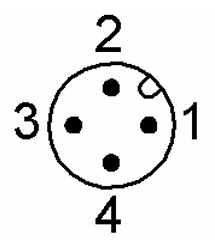
Pin |
2-wire signal |
3-wire signal |
Description |
|---|---|---|---|
1 |
U+ |
U+ |
Positive power supply |
2 |
NC |
NC |
Not connected |
3 |
U- |
U- |
Negative power supply |
4 |
NC |
S+ |
Analog output |
Note
For pin assignments, see also product label
Faults
Note
If faults cannot be eliminated by means of the listed measures, take the instrument out of operation immediately.
Contact the manufacturer
If a return is needed, please follow the instructions given in chapter Return
Note
Additional information can be found at www.balluff.com on the product page.
Note
No action needs to be taken if plastic parts (e.g. electrical connection) become discoloured. Discolouration is harmless.
In the event of any faults, first check whether the instrument is mounted correctly, mechanically and electrically.
Maintenance
This instrument is maintenance-free. Repairs must only be carried out by the manufacturer.
Cleaning
Only use commercially available and solvent-free cleaning agents.