Firmware for Balluff Update IO-Link devices and network modules
Oct 15, 2026 | 1322 words | 7 min reading time
Note
You can only update the firmware for Balluff network modules.
Note that only newer generation network modules support this feature. These network modules support the JSON for IO-Link interface. Upgrading is also possible with the new generation of USB masters.
You can update the firmware of the devices in two ways:
About the project to update the firmware of all network modules and devices of the topology in one step, see Update firmware for all devices in the topology.
To update only the firmware of a network module, see Updating the firmware of a device via device settings.
You can download the firmware from the cloud so that it is available locally in the BET database. Or you can import the firmware files manually into the BET database, see Import firmware file.
You also have the option to create a local firmware folder for which you can use for firmware updates.
Note
The update for the following network modules can only be performed under certain conditions:
BNI00HL
BNI00K4
BNI006A
BNI008M
BNI00HM
BNI00HW
BNI00H4
BNI00K5
You can find more information on this in the “Firmware update” chapter at Known Issues.
Update firmware for all devices in the topology
Click Topology in the function bar.
An overview of the network modules and their connected devices of the Balluff project is displayed.
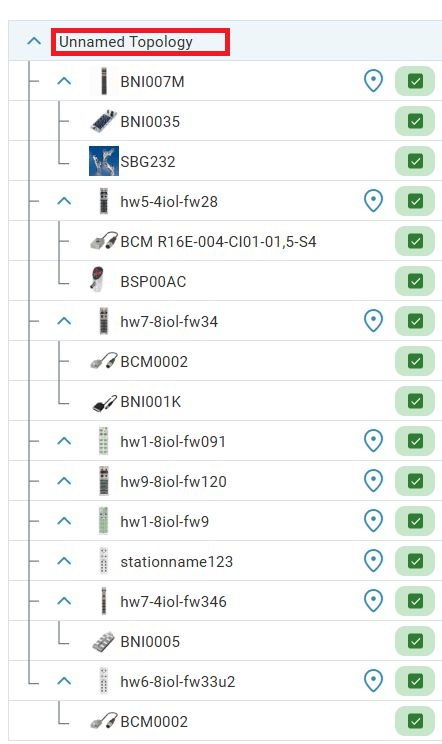
Open the Firmware tab.
You will see the currently installed firmware versions and the available firmware versions for all network modules and their devices in the topology, if firmware updates are available. If a product is present multiple times in the topology, the firmware update will always be performed for all devices in that product.
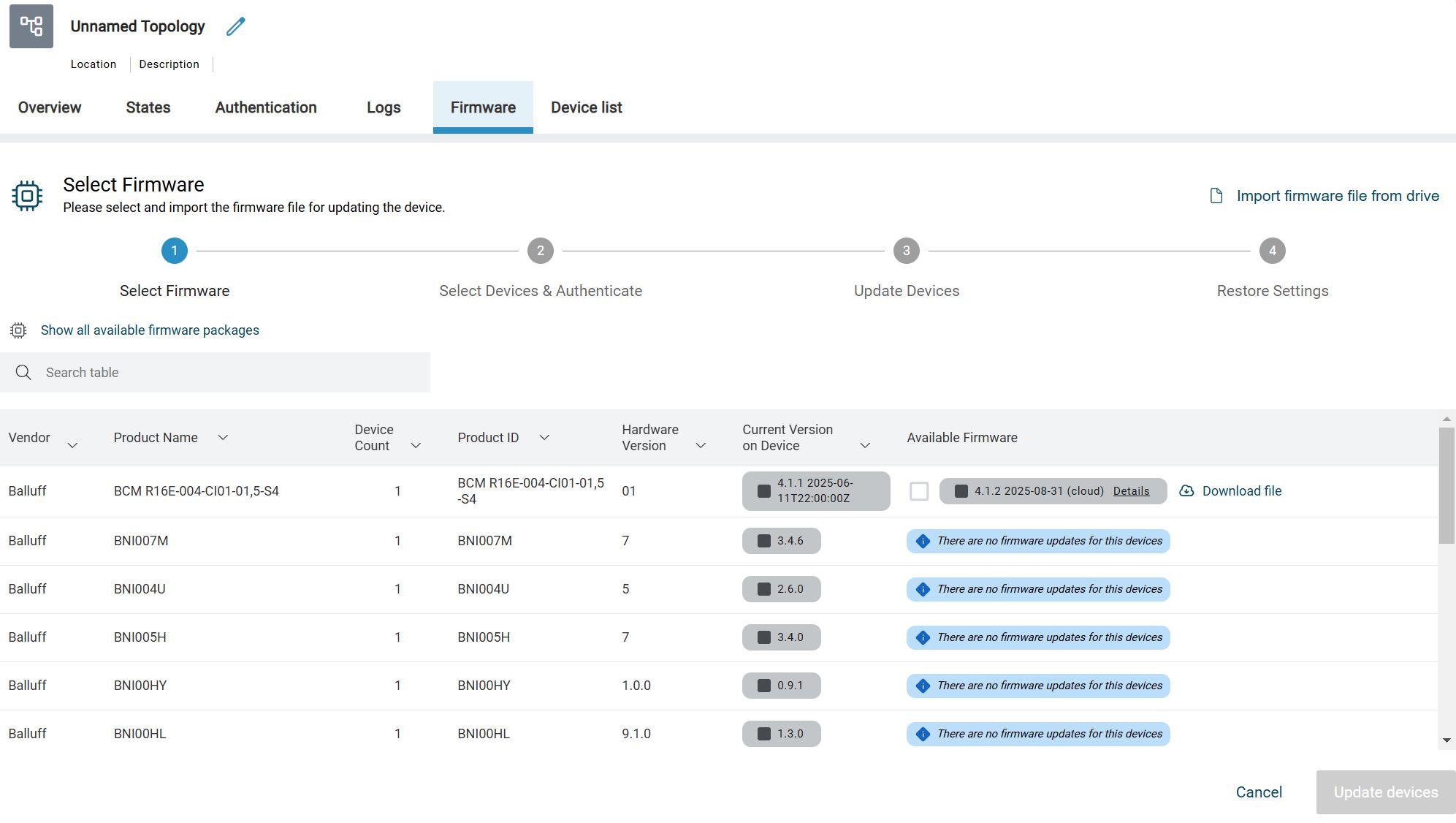
Note
You may need a password to update some devices, ask your manufacturer if the default password does not work.
Note
If no connection to the Balluff infrastructure for firmware update is possible, you will receive an error message.

Click Download File to download the firmware versions that you want to update the devices with.
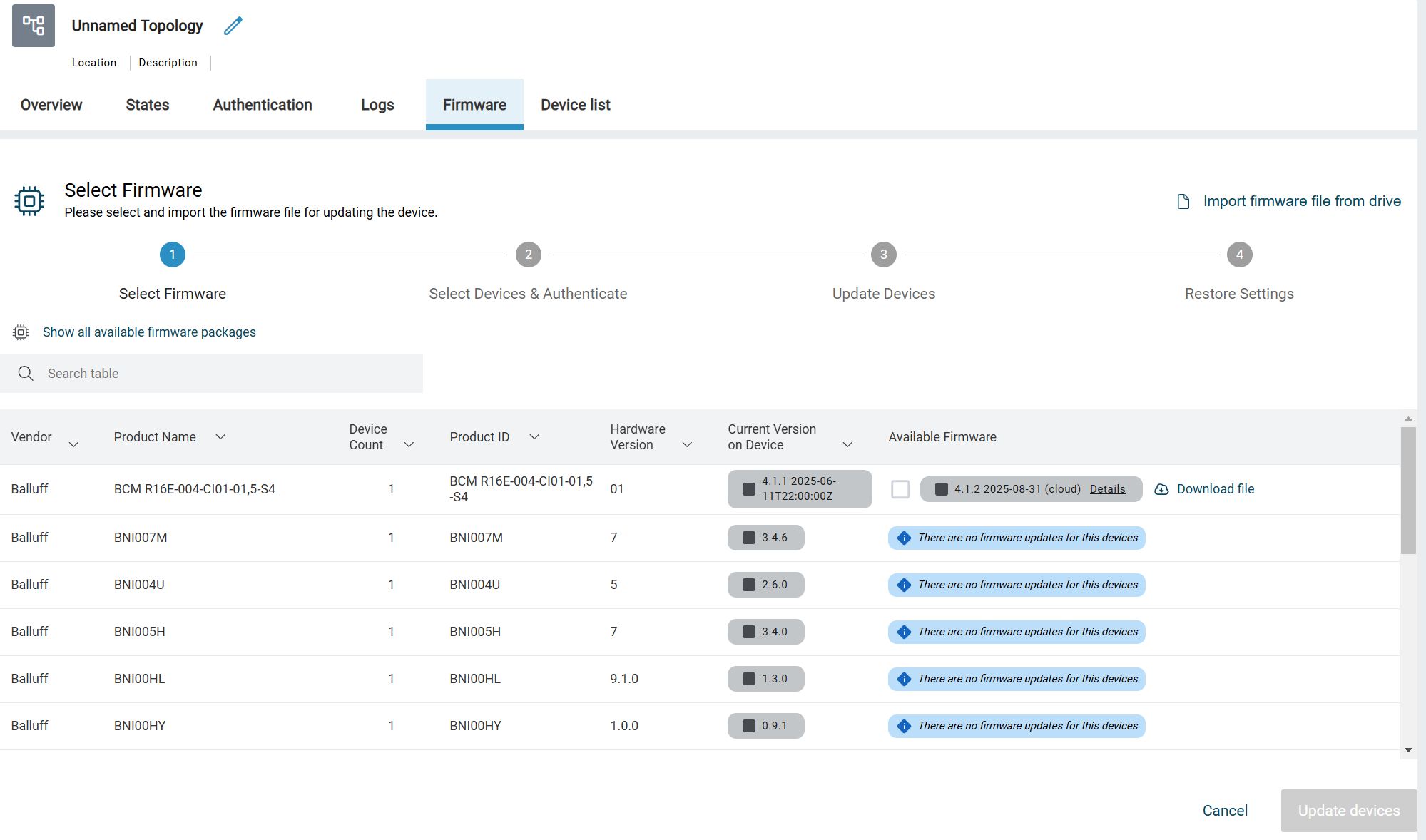
Downloading firmware.
When the firmware files download is complete, you can mark the desired devices for updating.
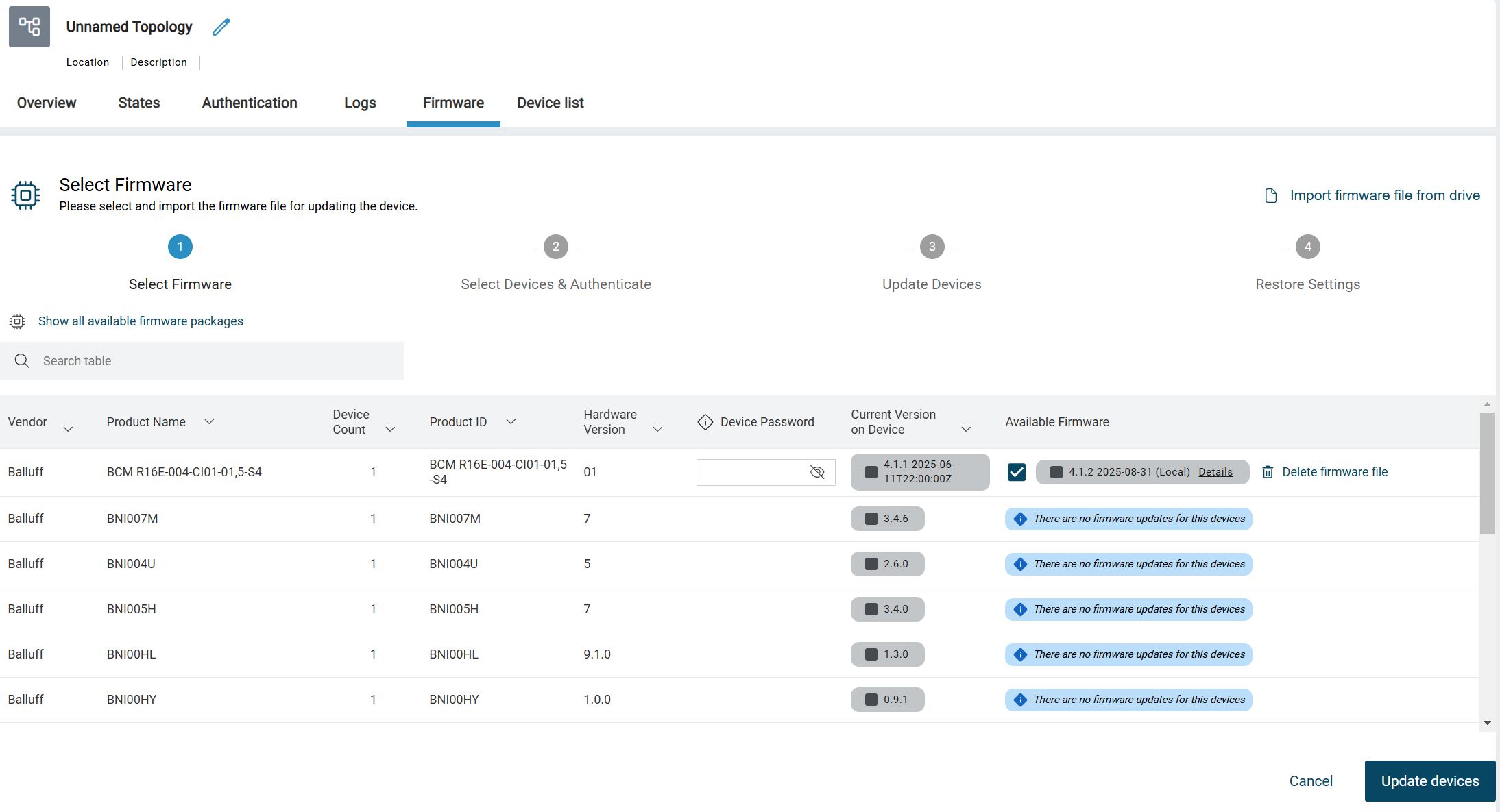
Click Update Devices to start the update.
The following warning message appears:
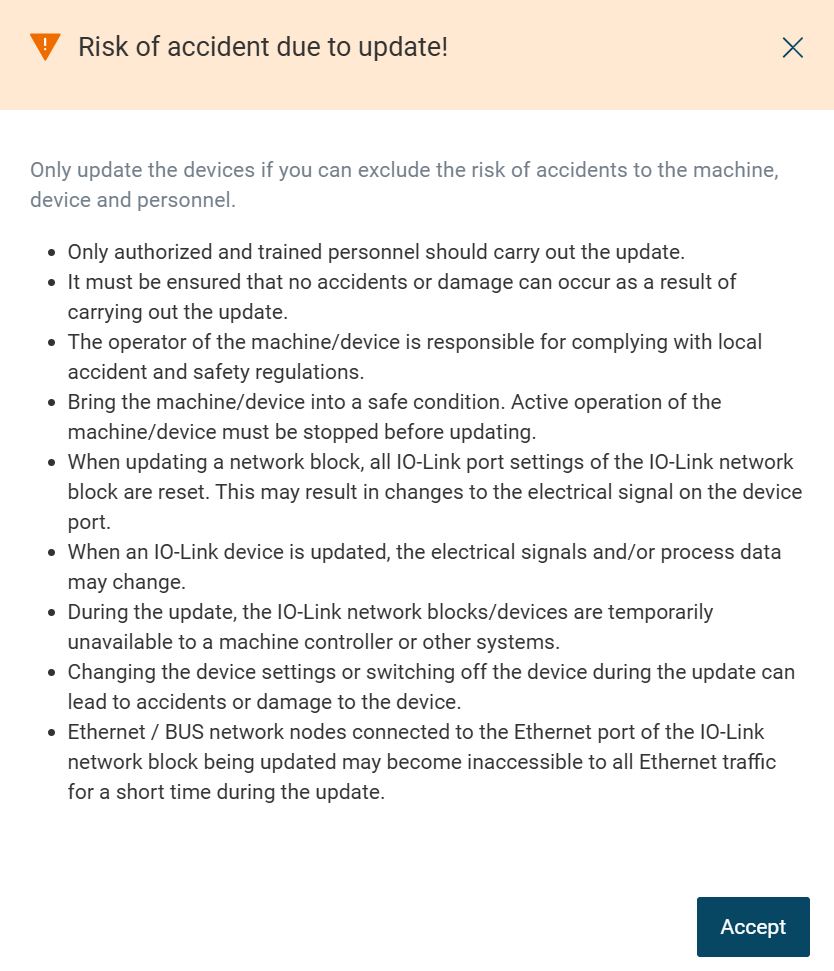
Read the notice carefully and click Accept.
If your selected devices require authentication, the following dialog appears.
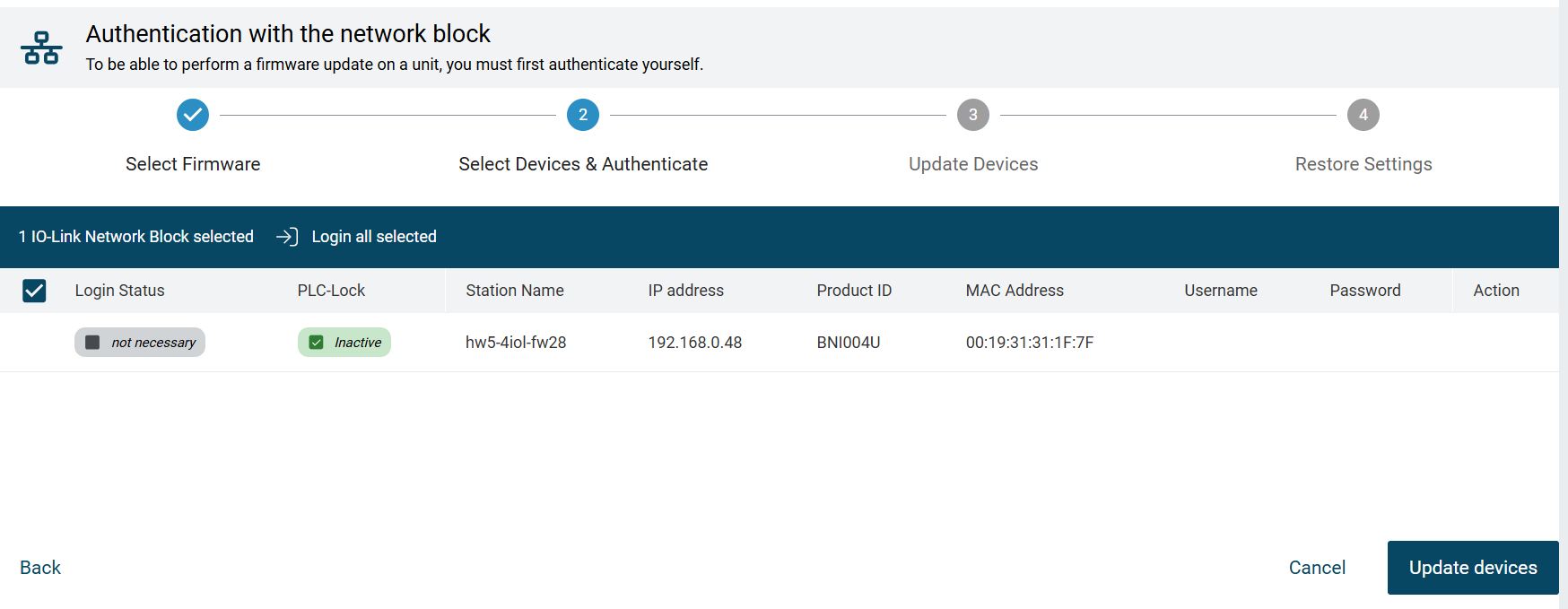
Select your devices and enter the appropriate data for an update.
Click Update Devices.
The following warning message appears:
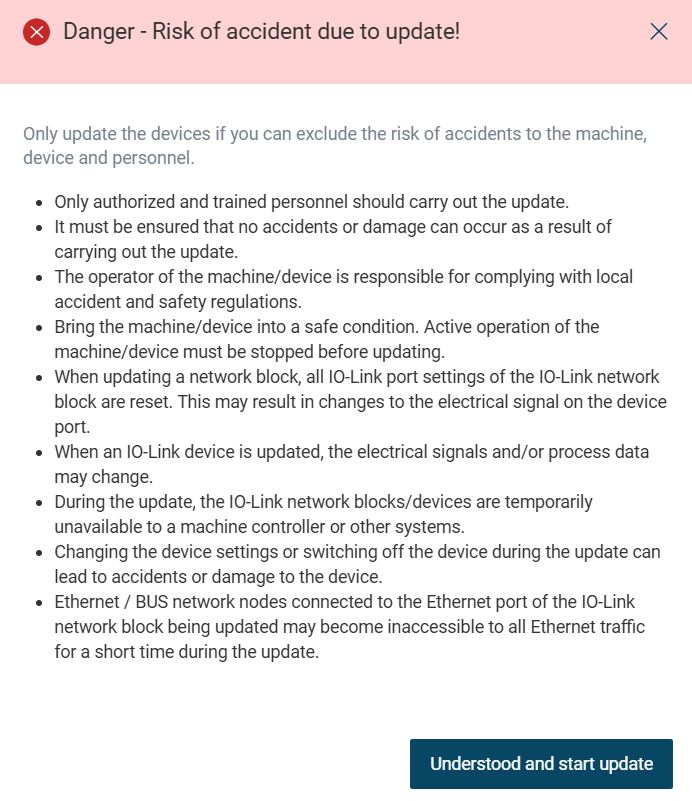
Read the notice carefully and click Understand and start updating.
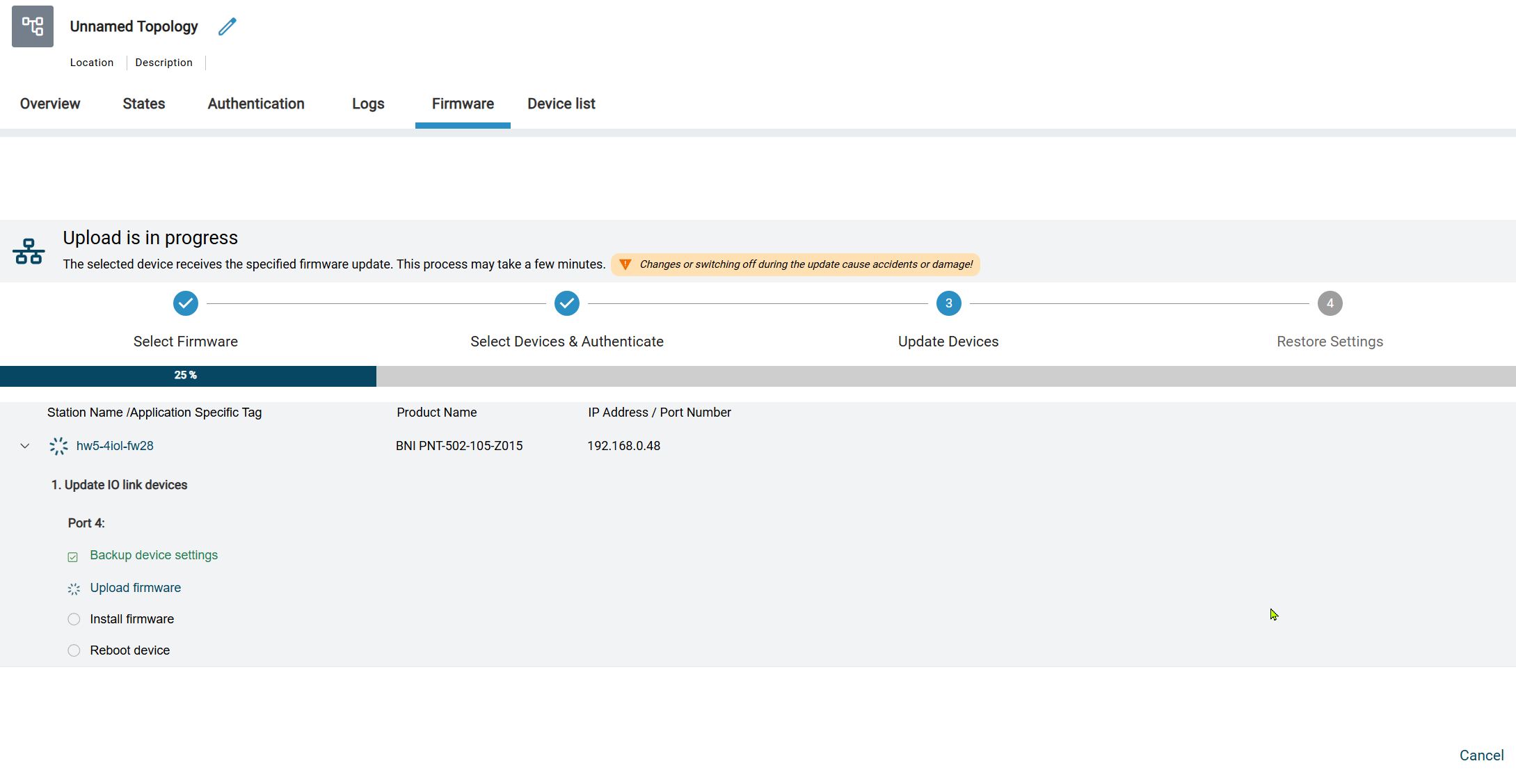
The firmware update is started for all devices in the topology. The progress is displayed. The current parameters of the devices are saved temporarily in an intermediate step.
The BET automatically restores the parameters for all devices whose parameter set is not changed by the update to the new firmware.
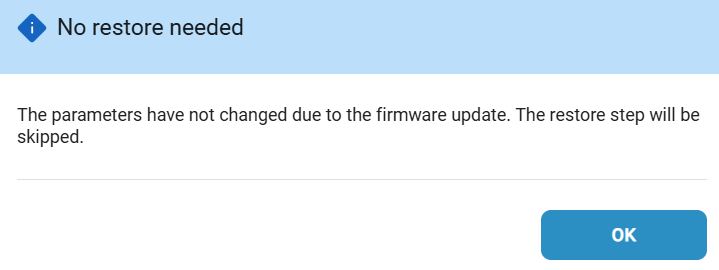
If no recovery is necessary, you will be informed:
In the event that a firmware update should have changed the structure of the parameters on an IO-Link device, you will be informed of the differences with the following information:
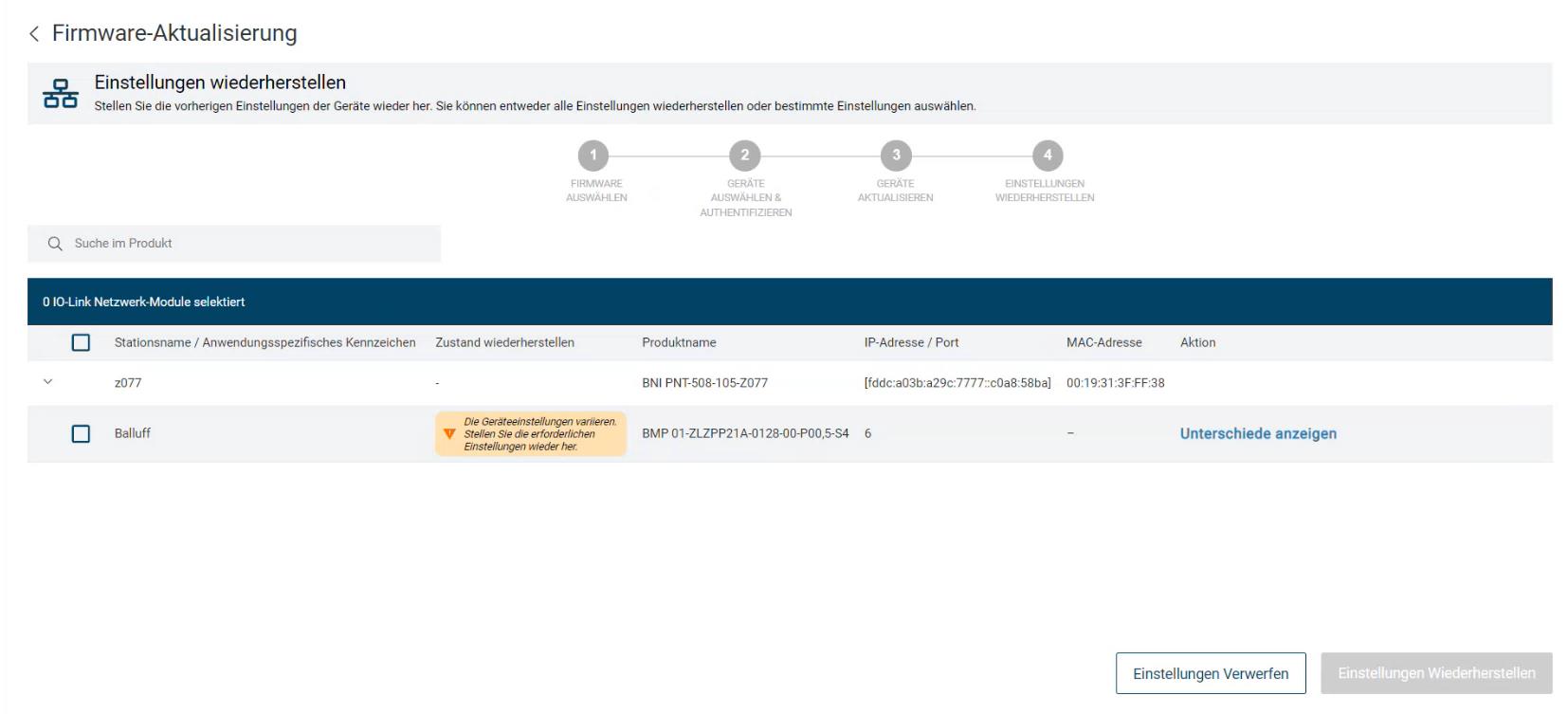
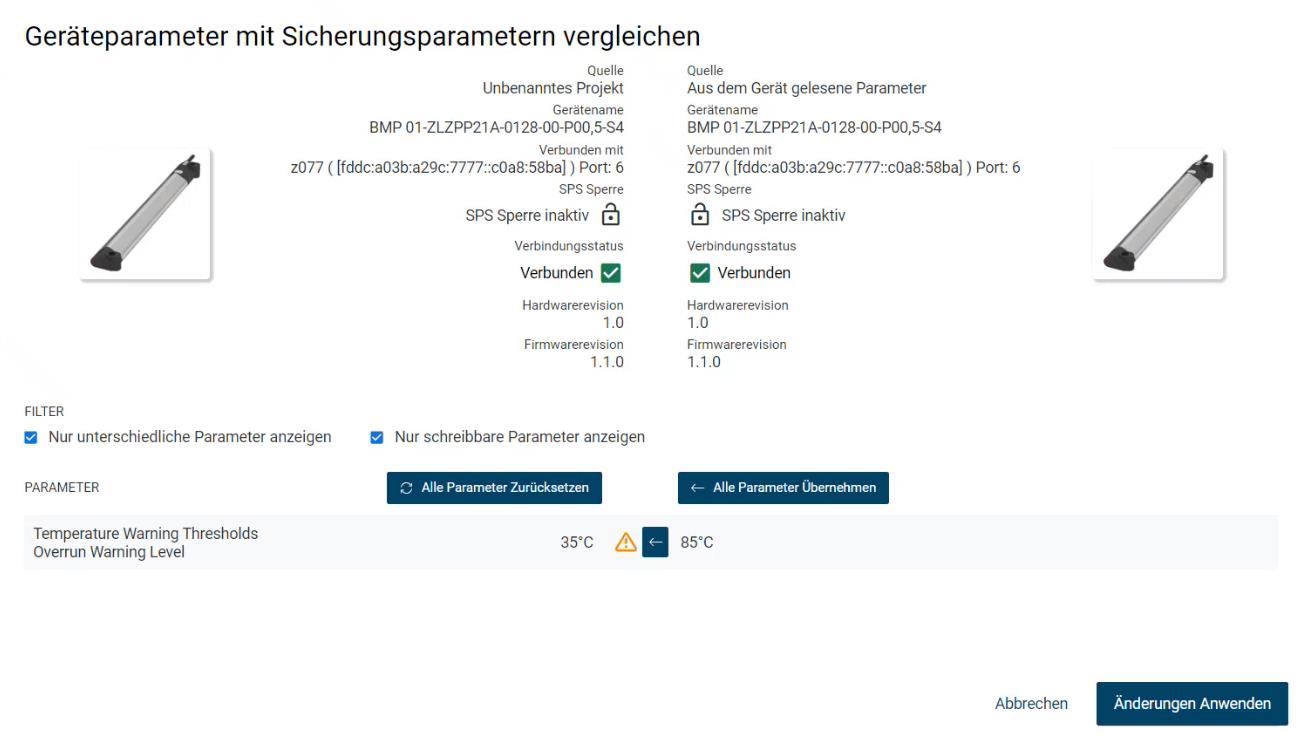
Click Show Differences to see all differences in the IO-Link device’s writeable parameters before and after updating, and you can then customize them.
Note
If parameter recovery does not need to be performed, steps 10 and 11 are skipped.
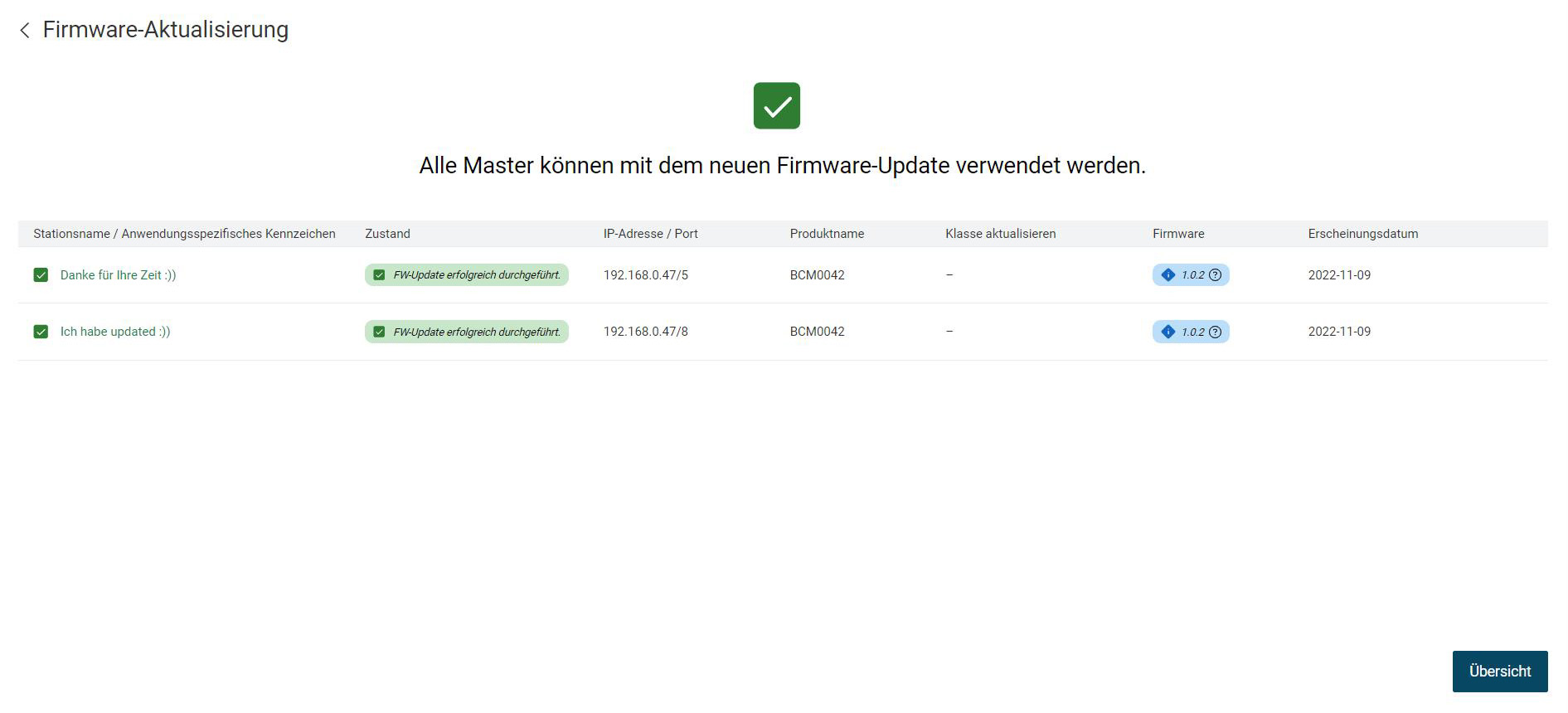
As soon as all devices have been updated or the parameters have been restored, the following dialog appears:
Note
If a firmware update for a device fails, you will be informed. In addition, firmware updates are saved in the activity log (LOG), see Perform troubleshooting with activity log (LOG).
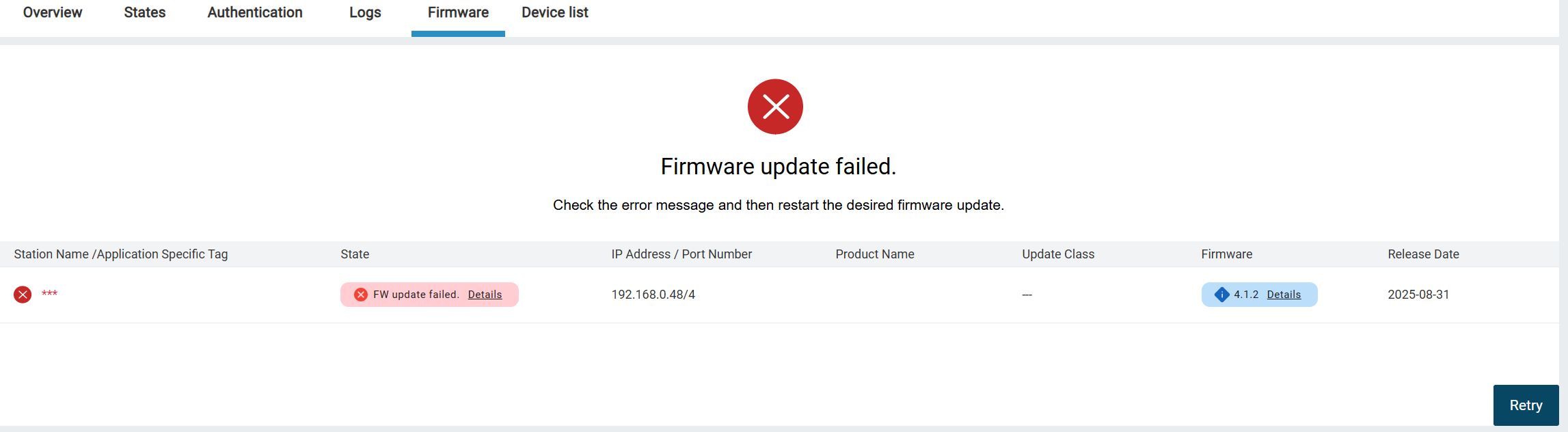
Click Repeat to repeat the update.
Updating the firmware of a device via device settings
Click Topology in the function bar.
An overview of the network modules and their connected devices of the Balluff project is displayed.
Select the desired network module whose firmware you want to update.
The device details are displayed in the detail view.
Select the Firmware Update tab.
The following tab is displayed:
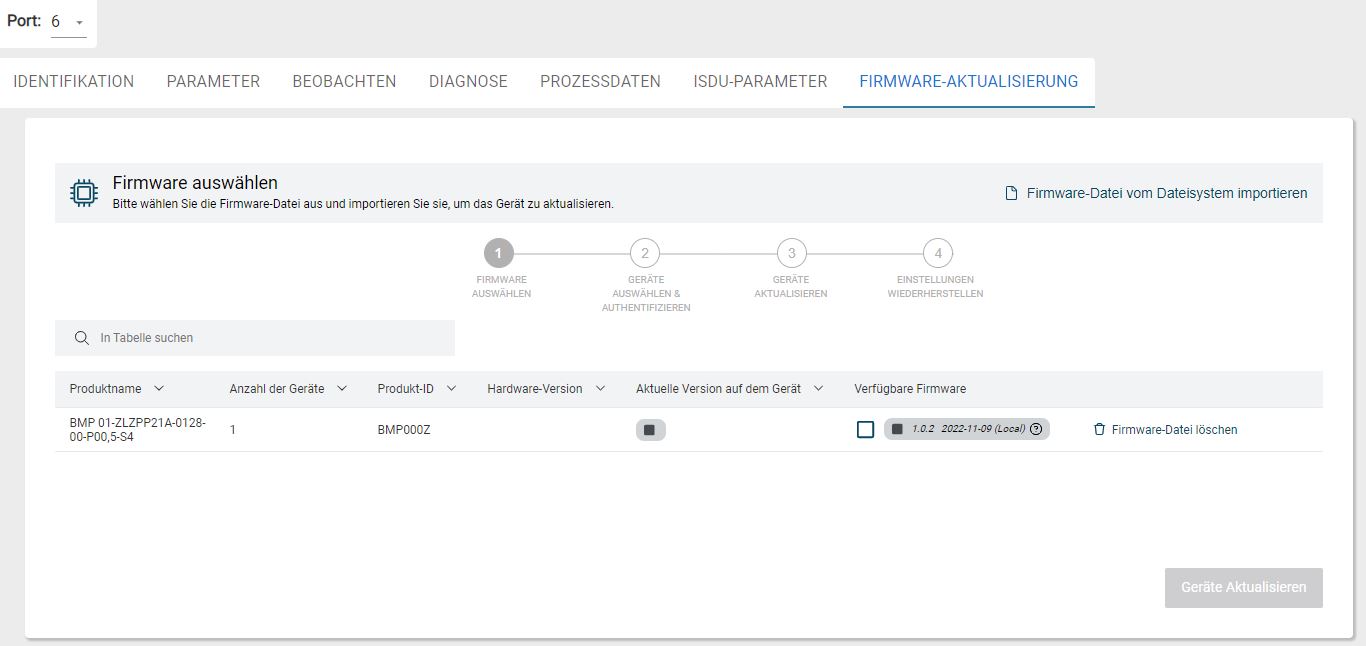
Firmware Update tab
For the selected device you will see the currently installed firmware version and the available firmware versions.
Note
If no connection to the Balluff infrastructure for firmware update is possible, you will receive an error message.

Select the desired firmware version with which the device is to be updated.
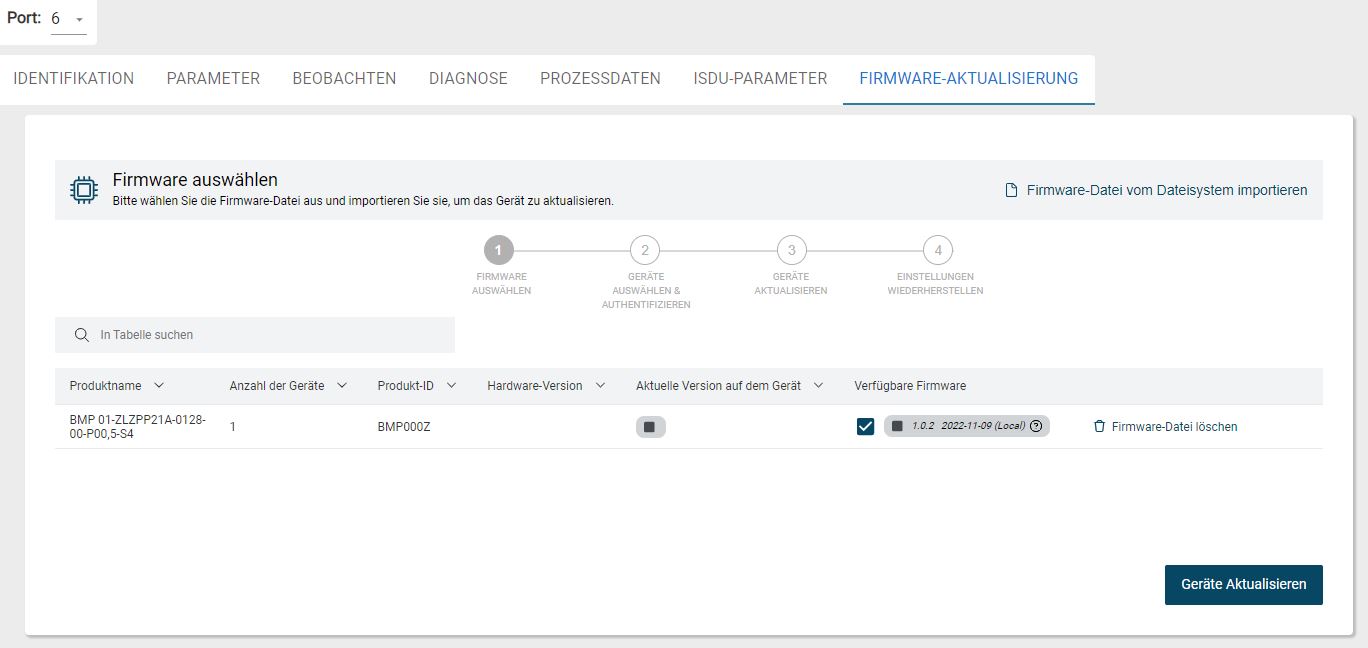
Click Update Devices.
The following warning message appears:
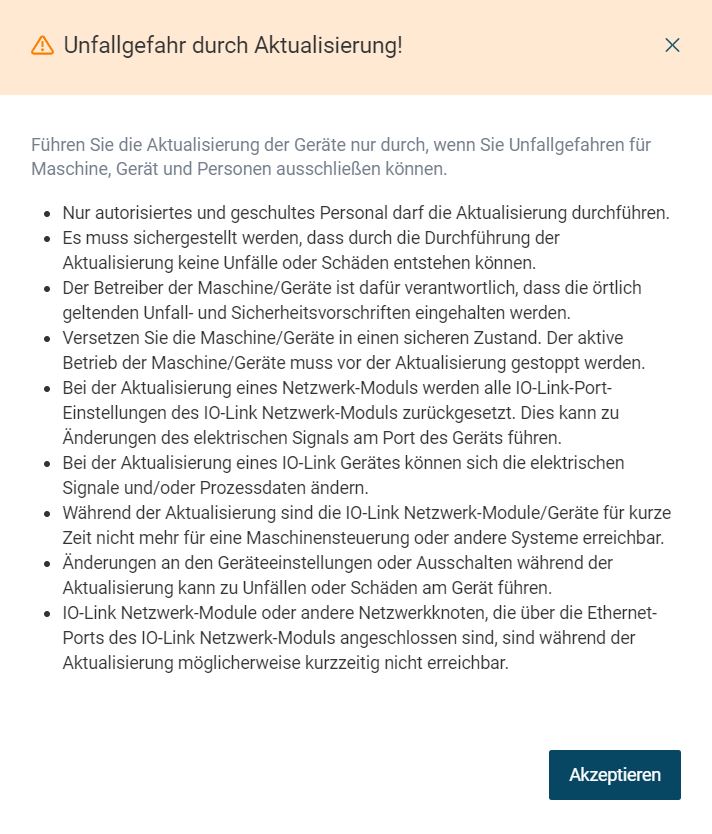
Read the notice carefully and click Accept.
If your selected devices require authentication, the following dialog appears.
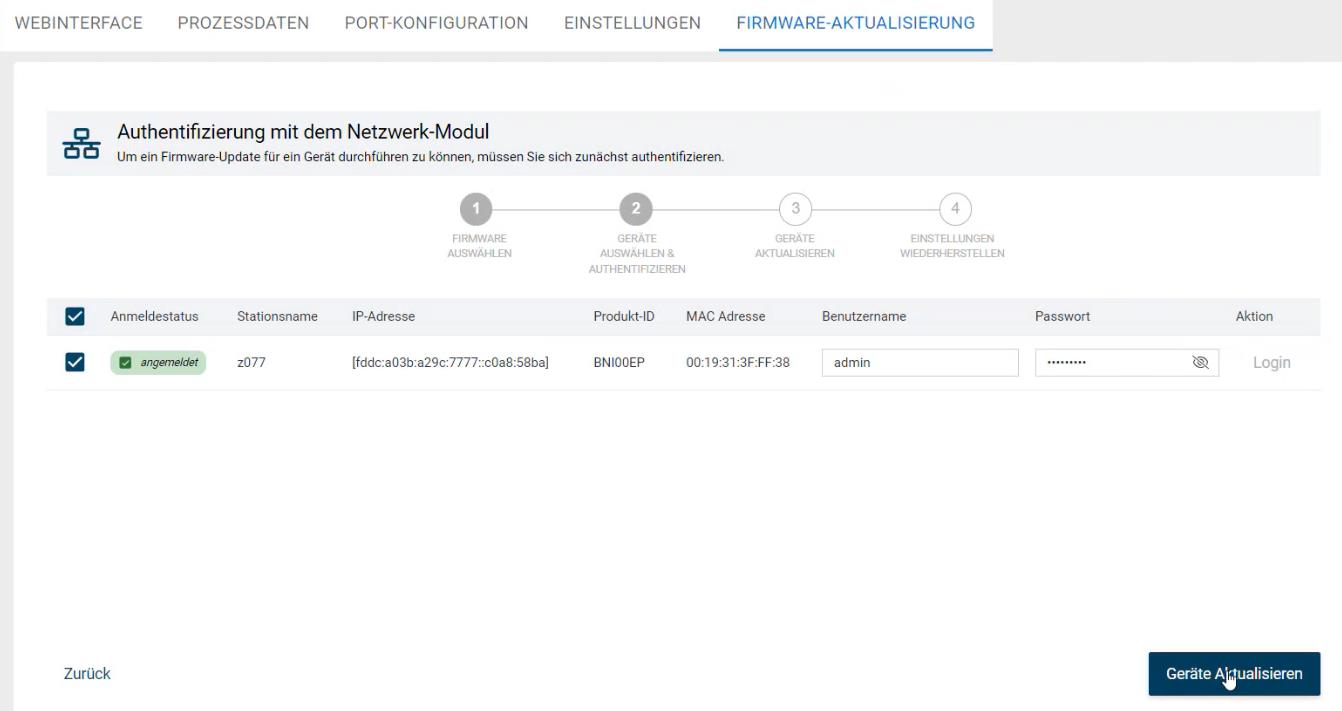
Mark your devices and enter the appropriate authentication data for an update.
Click Update Devices.
The following warning message appears:
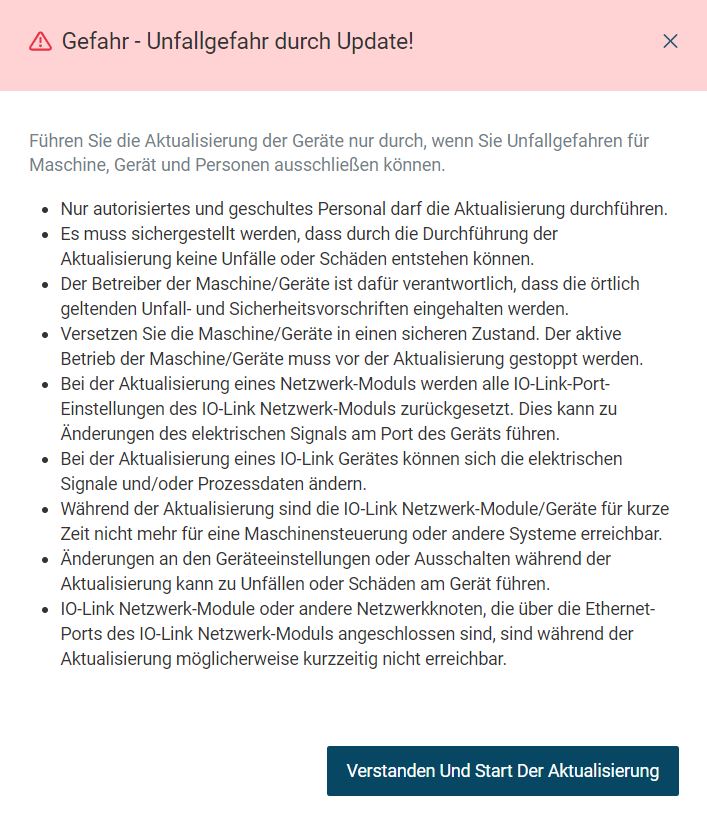
Read the notice carefully and click Understand and start updating.
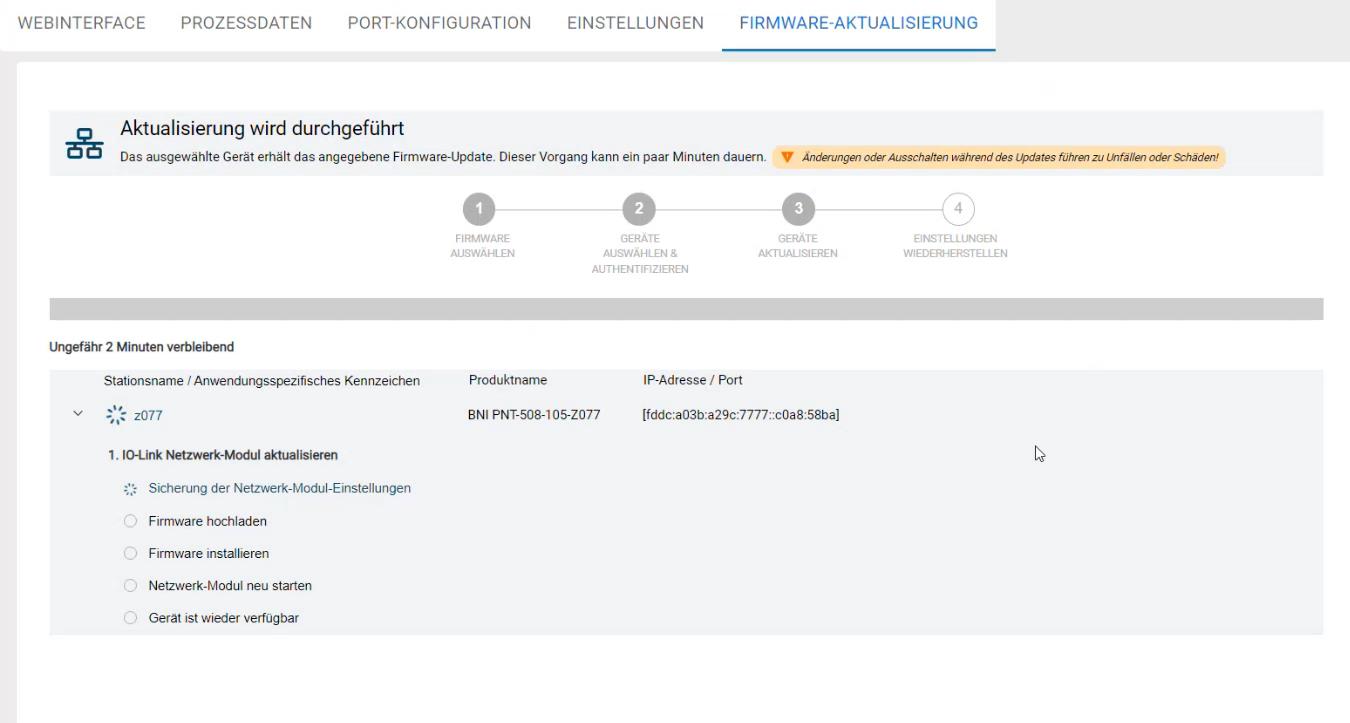
The firmware update for the device is started. The progress is displayed. The current settings of the device are temporarily saved in an intermediate step and the settings are restored once the firmware update has been completed:
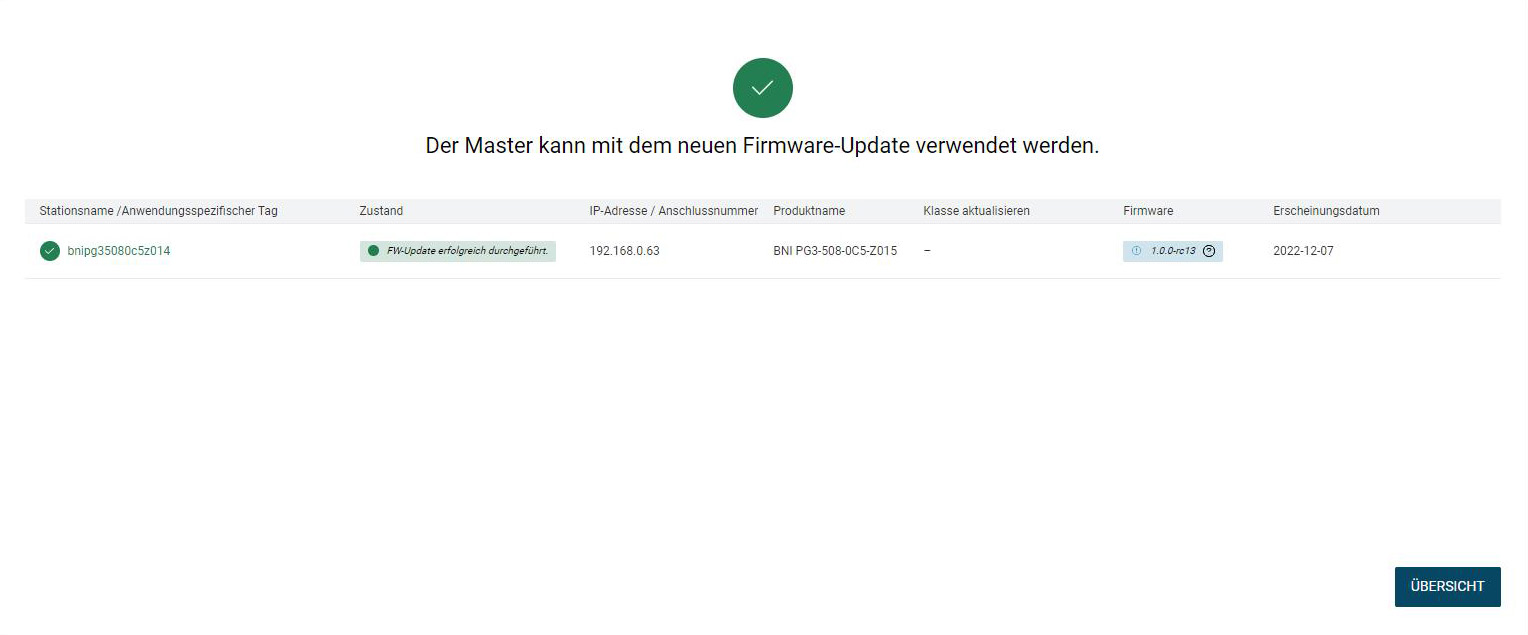
Once the IO-Link network modules have been updated, the following dialog appears:
Note
If a firmware update for a device fails, you will be informed. If you click on the question mark icon, you will be shown details of the failed update. In addition, firmware updates are saved in the activity log (LOG), see Perform troubleshooting with activity log (LOG).

Show information about firmware
You can view detailed information about available firmware, such as the release date, compatibility information, and a change history.
Open the firmware update either for all devices in the topology (see Update firmware for all devices in the topology) or for an individual device (see Updating the firmware of a device via device settings).
Click the question mark icon (
 ) for an available firmware.
A dialog with information about the firmware appears:
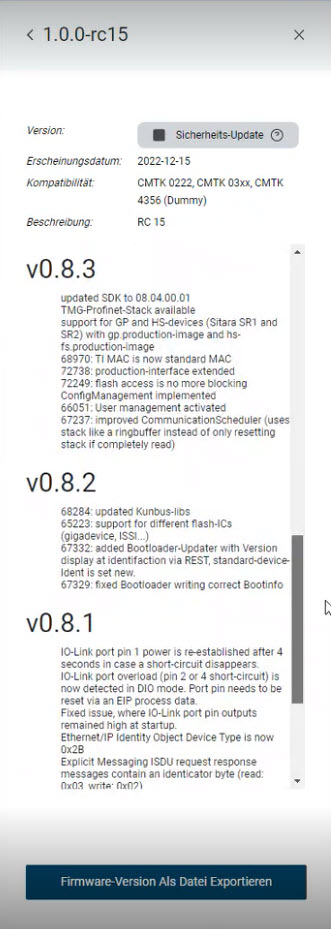
Export firmware file
You can export available firmware from the cloud or the BET database as a file and then make it available on offline systems, for example.
Open the additional information about the firmware, see Show information about firmware.
Click Export firmware file as file.
You will be prompted to save the file to the file system.
Choose a location, assign a file name, and click Save.
The export is complete and you can now import the file into offline systems.
Import firmware file
Open the firmware update either for all IO-Link devices (see Update firmware for all devices in the topology) or for a single IO-Link device (see Updating the firmware of a device via device settings).
Click Import firmware file from file system.
The following dialog appears:
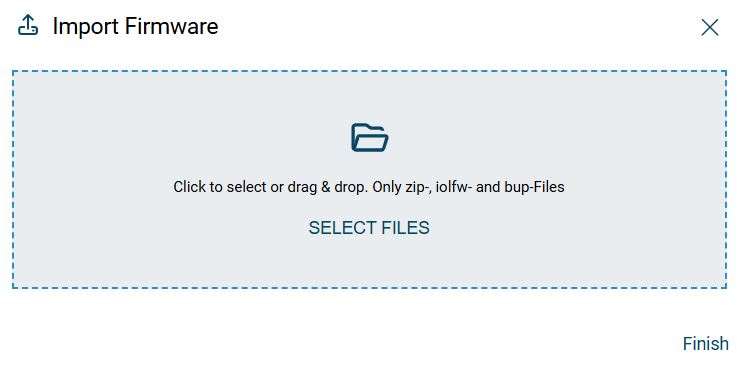
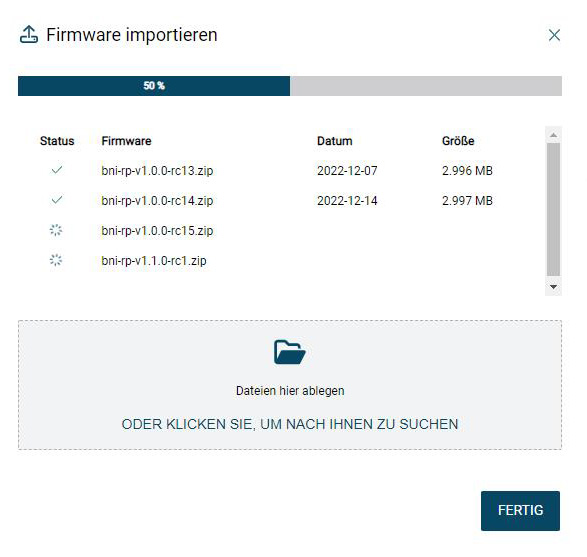
Hold down the left mouse button and drag the desired firmware file within the dotted frame and release the mouse button to upload it. Alternatively, you can also click within the frame area to select the file in the file system. The firmware file is imported. The progress is displayed:
Note
If you import ZIP files that are not suitable for a firmware update, a corresponding message is displayed:

When the firmware file has been imported, click Done.
The import is complete and you can now update the IO-Link devices.
See all available firmware updates
In addition to firmware updates for the devices you use in the current topology, you can view all firmware updates currently available in the cloud or the BET database.
Open the firmware update either for all devices (see Update firmware for all devices in the topology) or for a single device (see Updating the firmware of a device via device settings).
Click View all available firmware.
All currently available firmware updates in the cloud (
cloud) or in the BET database (local) are displayed: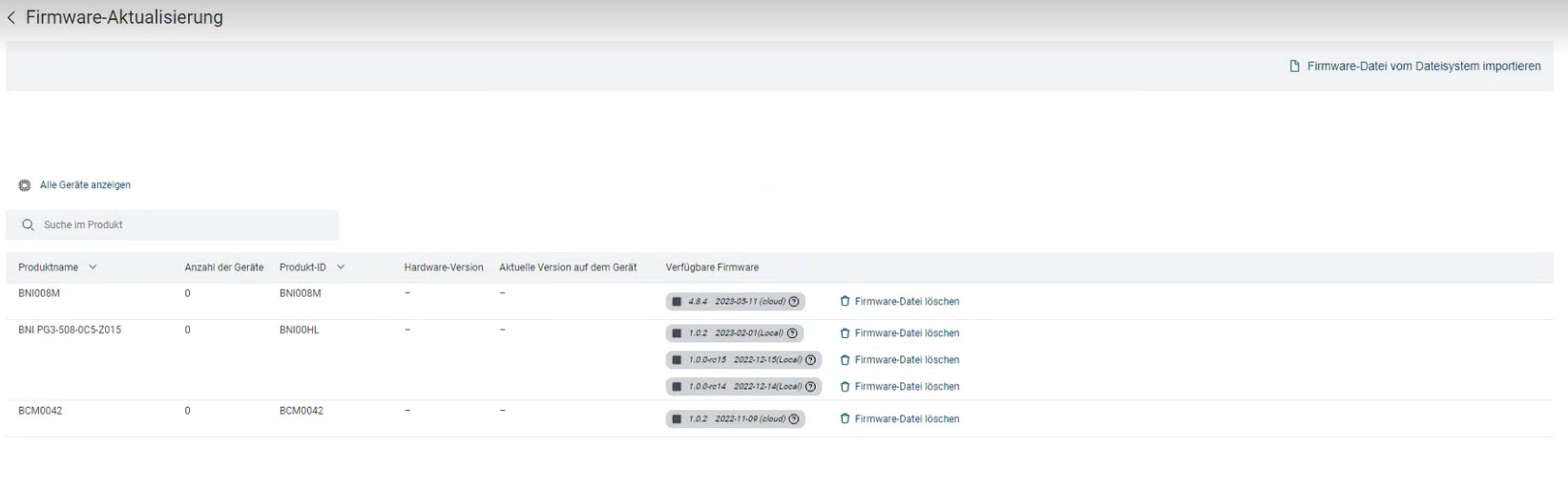
To return to the previous view, click View all devices.
Delete firmware file
You can delete available firmware versions from the BET database.
Open the firmware update either for all devices (see Update firmware for all devices in the topology) or for a single device (see Updating the firmware of a device via device settings).
For available firmware, click Delete firmware file*. The following dialog appears:
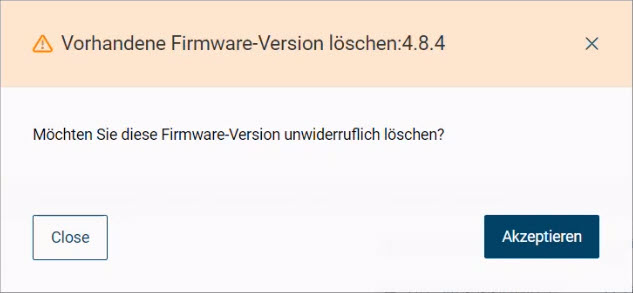
Click Accept. The firmware file will be deleted.
Reset device if no IODD was found (DEVICE DETAILS)
It may happen that a device does not find an IODD after a firmware update, and the device appears as a generic device, in which case you can reset the device as follows:
In the topology, select the generic IO-Link device and click DEVICE DETAILS in the toolbar. The detail view appears in the workspace.
In the function block, select REBOOT DEVICE. The IO-Link device is restarted and updated.
Reset device if no IODD was found (UPDATE IODD)
You can also reset the device in the following ways:
In the topology, right-click the generic device and select IODD UPDATE. The following warning message appears:

Read the note text and select the desired option.
Firmware update using a local firmware folder
You also have the option to use a locally created folder for firmware updates instead of connecting to the Balluff Update Platform (BUP).
To do this, you must first create such a folder and place the required files in that folder.
Create a folder for your firmware files:
Click on “User Settings” in the top bar.
The user settings sidebar opens.
Scroll to the “Setting up a local firmware folder” setting and enable it.
Settings for selecting a local folder are displayed:
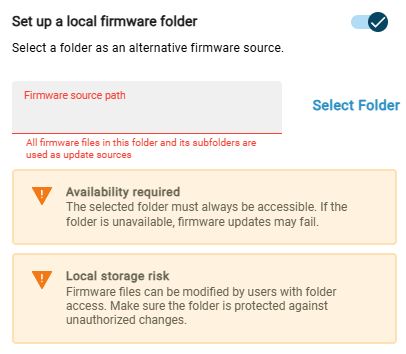
Specify a path to your local folder (e.g. C:\Users\userxyz\Desktop) or select Select folder to select a folder using Windows File Explorer. Read the warnings carefully.
Click Save Settings to save your changes and exit the Settings window.
When the settings are saved, the folder created is automatically used the next time you update firmware.
Note
To access the BUP again, disable the function in the settings.