OPC-UA Basics
Description
This BNI product provides a server compliant with the OPC Unified Architecture (OPC UA) standard, with data closely aligned to the “OPC UA for IO-Link Companion Specification (OPC 30120)” [1]
In this chapter you can find:
Brief sumary about OPC UA
First steps activating the OPC UA Server
References about OPC UA object
Useful PC app (tool) and scripting examples
Which IIoT fits for your application and/or Use Case, here is a comparison
MQTT |
REST |
OPC UA |
|
|---|---|---|---|
Communication type |
Asynchronous (Publish/Subscribe) |
Synchronous (Request/Response) |
Client/Server |
Bandwidth |
very low |
medium |
high |
Security |
Medium |
High |
Very high |
Complexity |
Low |
Medium |
Medium |
Area of Application |
IIoT, Sensors, Edge Devcies |
Cloud, Webservices, other APIs |
Automation, Monitoring |
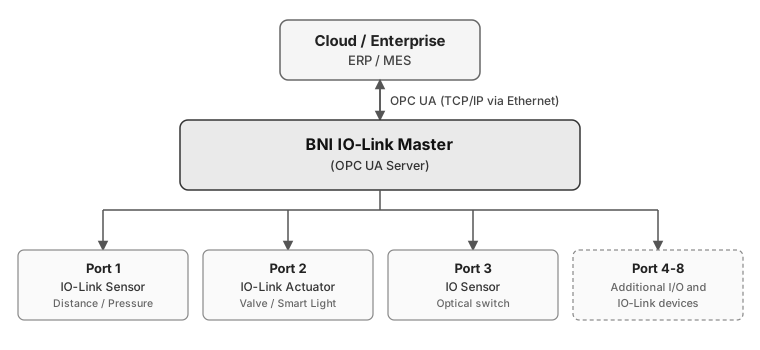
Typical OPC UA architecture
The picture shows a typical OPC UA architecture.
Supported data via OPC-UA
It provides access to the following data related to:
Master (module unit itself):
Identification data
Ports:
SIO Input and Output signal states
Identification data of the connected IO-Link devices
Process Data Input and Output of provided by the connected IO-Link devices
Diagnostic and status information of the connected IO-Link devices
Note
Capabilities and Limitation
OPC-UA Server provides data as read only (in firmware 1.4.0)
Process Data Output can also be read back
Login required (user: admin, password: lasered on the product)
No anomymous login allowed
User name and password are transmitted without encryption
Data refresh rate: ~10 ms
Summary of terms used in OPC UA
Term |
What it conveys in the sentence |
|---|---|
Address Space |
The browsed “location” or structure (the server’s entire tree-element system). |
Information Model |
The structure summarizing data meanings, types, and relationships. |
Browse / Traverse |
The official OPC UA term for retrieving nodes. |
Node Metadata |
Encompasses data types, Namespaces, and attributes. |