Geometric Effects#
The geometry of both the package and the target object has a strong influence on how radar waves are reflected and how structures appear in the reconstructed image. Even if the material itself is suitable for radar inspection, unfavorable surface shapes or viewing angles can reduce visibility or change the apparent shape of the object.
Aerial constraints#
The RadarImager mainly measures reflection components that return to the antenna along the same path on which they were emitted. This is illustrated by the dotted arrows in the images below.
For a straight, flat surface, the amount of energy reflected back to the antenna depends strongly on the viewing angle. At larger angles, less energy returns directly to the sensor. However, because the object moves during the scan, the RadarImager collects reflections from many different positions. These measurements complement each other during reconstruction and improve the final image.
For rough surfaces, the basic principle remains the same, but the local surface angles can increase scattering back toward the antenna. As a result, rough structures may appear more clearly in the brightness image than very smooth surfaces at unfavorable angles.
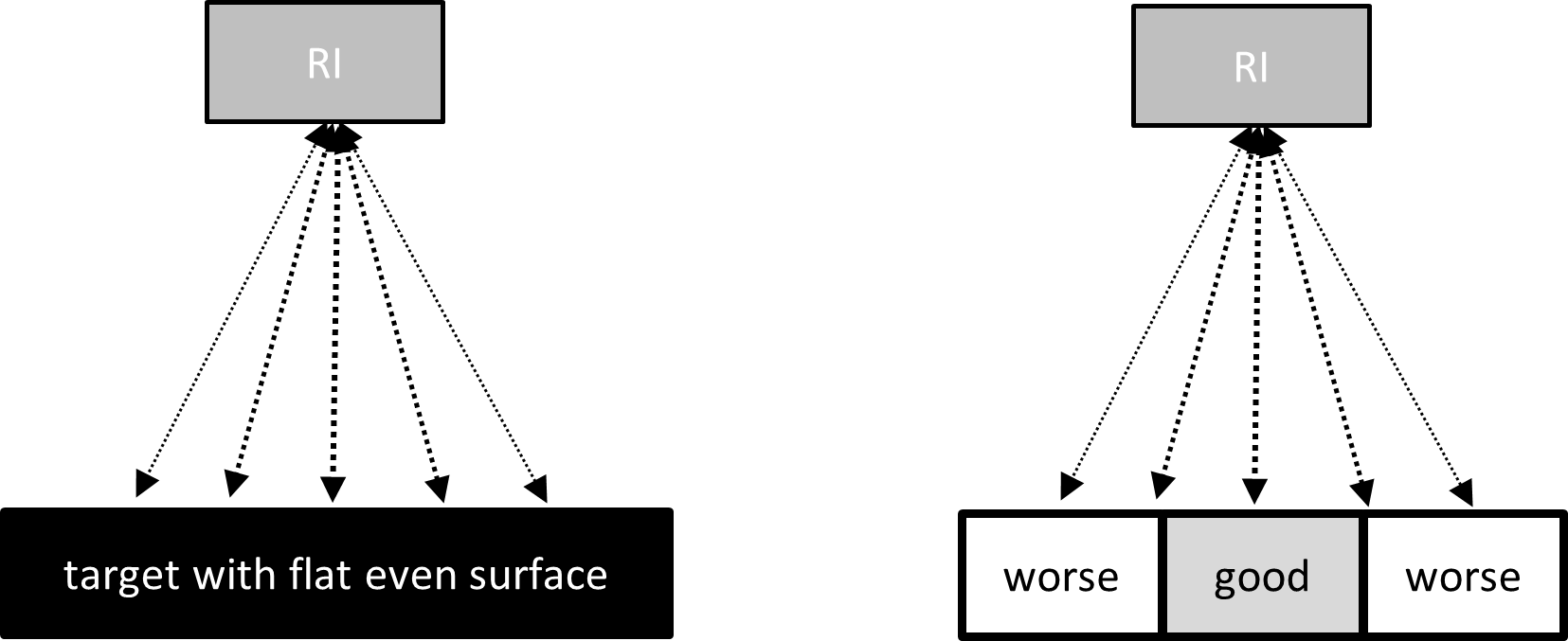
Reflection behavior depends on the local surface angle relative to the antenna view.
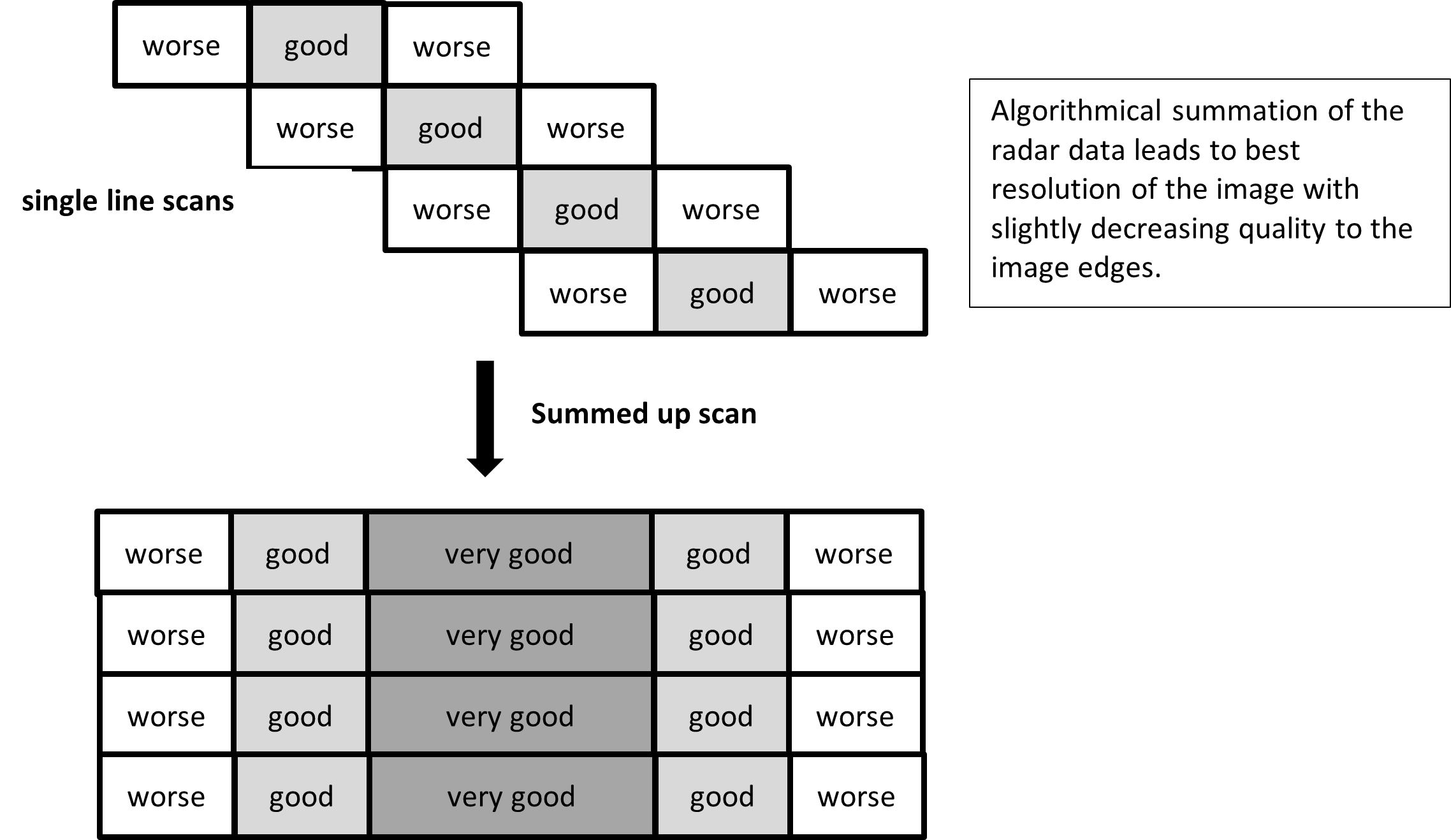
Rough surfaces can scatter more energy back toward the antenna and may therefore appear brighter.
Round geometry#
If the target surface is round, only a limited part of the surface reflects energy directly back to the antenna. The farther the local surface deviates from a perpendicular orientation to the incoming radar wave, the fewer useful reflection paths remain.
For this reason, spherical objects are typically reconstructed as small bright spots, while cylindrical objects often appear as narrow bright lines. The larger the radius of the object is, the larger the visible reconstructed region becomes, because the surface remains closer to a locally flat orientation over a wider area.
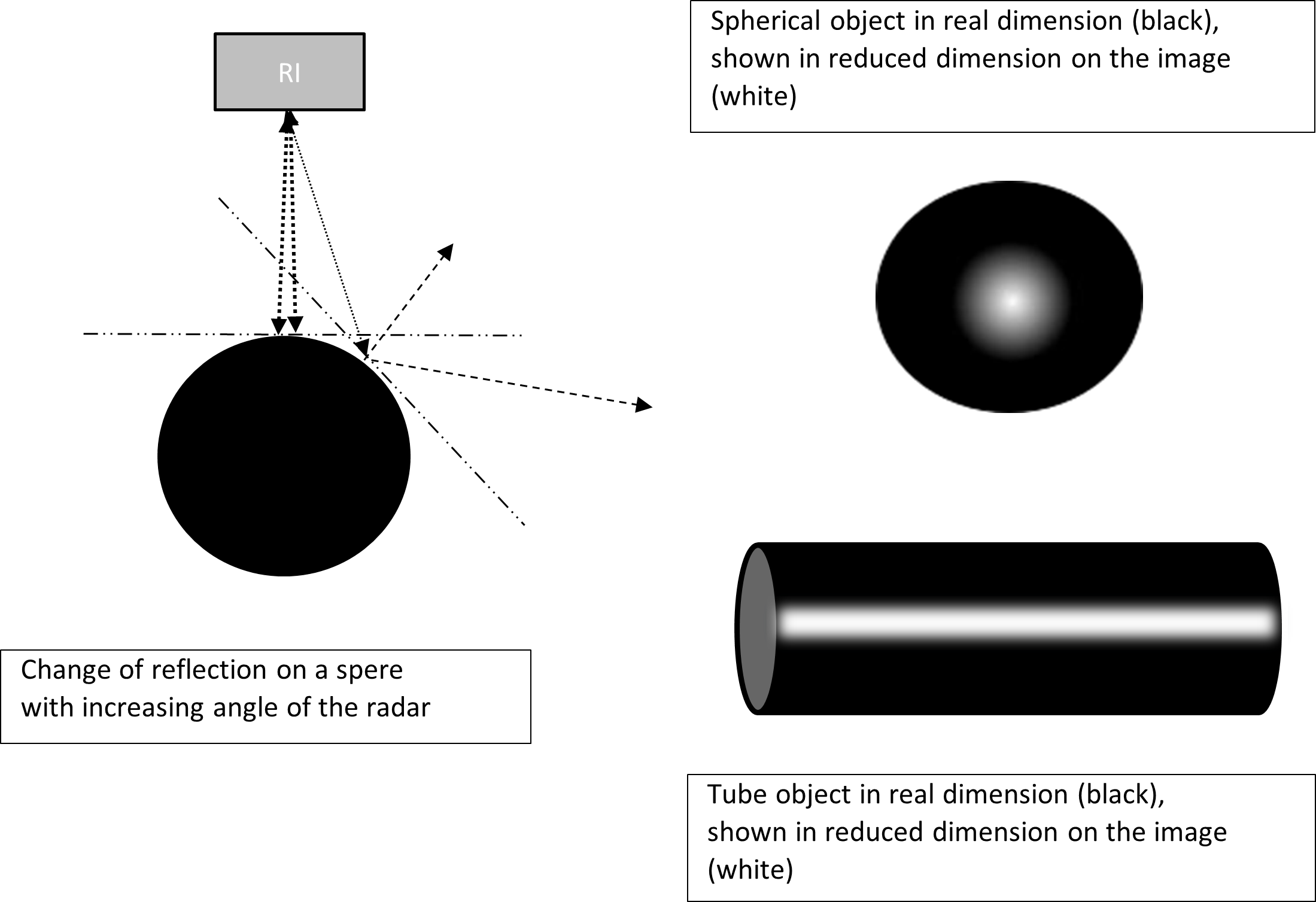
Round objects are only visible in the regions where the local surface orientation still returns energy to the antenna.