Material Effects#
Materials located between the RadarImager and the target object influence how the radar wave propagates and how the resulting image has to be interpreted. Depending on the material and geometry, they can change the propagation path, blur structures, reduce signal energy, and limit visibility of deeper layers.
Refraction#
Any dielectric material located in front of the actual target object within the scan volume, for example packaging, affects the radar wave. It changes the propagation angle, the time of flight, and the transmitted energy. As a result, structures behind this additional material are typically reconstructed with some blur.
The thinner the intermediate material is, for example carton, a plastic housing, or foil, the smaller this effect becomes. For this reason, objects inside air-filled packages can usually be reconstructed more accurately than objects embedded in solid materials such as injection-molded parts with inserted targets.
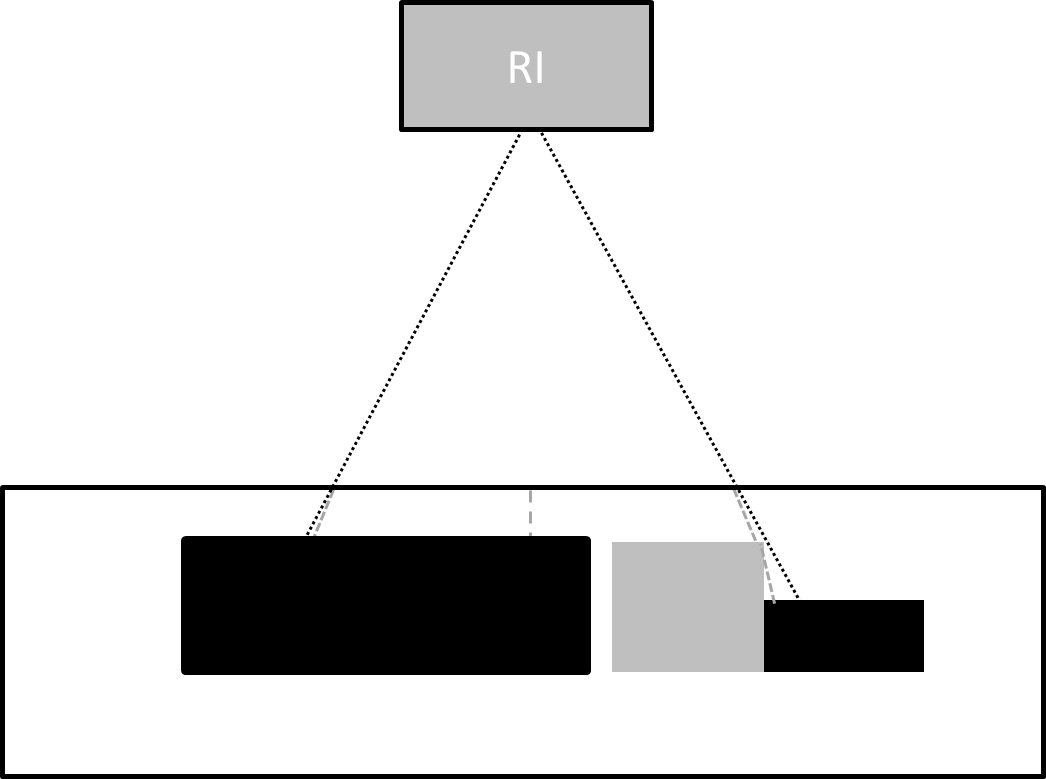
Explanation: The dotted lines indicate the ideal paths of the radar rays toward the target object. The outer box represents a carton package filled with air. The dashed grey lines illustrate an example of local ray deflection relative to the ideal path (black dashed line) caused by the packaging or nearby material volume. This leads to deviations in the reconstructed target image.
If the packaging geometry is more complex than a simple rectangular shape, additional effects occur. See also Geometric Effects.
Partial transparency#
Each reflection at a dielectric material transition reduces part of the wave energy. As a result, less information remains available for deeper reflection layers. This reduces image quality and effective resolution for structures farther below the surface. In extreme cases, deeper reflections are reduced to the noise level.

Special case: Metal objects act as full reflectors and are therefore usually clearly visible, even when the structure is small. However, they also shield the region below them, because the radar wave cannot penetrate the metal and therefore cannot reach the structures underneath.